Saturday, January 3, 2015

The New Year Resolution 2015: My One Word

And the New Year starts and we start our New Year Resolution.
While adamantly refused to set any Resolutions/ Goals since it the beginning of the year.
Later discovered the power of One Word as a way to reduce ambiguity and a reason to define and create a theme for the year.

And so, I chose my one word: SURRENDER

Cast all your anxiety on him because he cares for you. - 1 Peter 5:7

Many fail to see the opportunities that comes as blessing in disguise. We fail to recognise that problems or curses are in fact a way that God is testing our faith and belief on ourselves, on Him. It is a character-building process. The process helps us to put us back on track. It also helps us appreciate the things in life by showing us the worst possible scenario. To help us learn magnaminity, forgiveness and humility. Heard being said that those problems are way of your karma gets balanced - so appreciate the negativity because it is solving your karmic issues.

My one word for the Year 2015 is SURRENDER. I surrender my agendas to God. I surrender those that happens to me as plays of God. Kalam notes incidences of God suggesting him ways through innocent opportunities that otherwise goes unnoticed. I surrender my senses to pick up those opportunities as suggestions from God. I surrender my loyalty as an 'employer' to the organisation I work with. I surrender these 'ordinary' moments in life considering thems as opportunities to surrender my agenda for God's.

Here is my prayer/ resolution for this Year 2015:

Dear God, 
I surrender myself unto thee. 
I promise to
  • Surrender to my work
  • Surrender to the love that my wife showers upon me
  • Surrender to God
  • Surrender to the ebb and flow of life
  • Surrender to the momentum of living
  • Surrender to joy it brings, pain it harbours and the lessons it teaches
  • Surrender to one's karma
  • Surrender to the mission of my organisation
  • Surrender to the love of people around me
  • Surrender to the innocence of children 
“Good morning, This is God. I will be handling all of your problems today. I will not need your help, so have a miraculous day.” - Wayne Dyer, The Power of Intention
God Bless You!

Yours
Sathya


Wednesday, December 31, 2014

Useful Printable Templates for Year 2015

Wishing my readers a very Happy New Year 2015!

With the New Year coming, we all wanted printable formats and templates to help us organise ourselves and our life. 

Here are my top 5 useful printable formats and templates for Year 2015.
You can download them as pdf files and print it out for your use, all free of cost. 

1. Calendar: Everybody needs a calendar - for work and for life. Here is a simple calendar for Year 2015 in horizontal and vertical format. 

2. Planning: 

3. Goal setting:

4. To-do list:

5. Resume/ CV: 

Tuesday, December 30, 2014

5 Steps to Getting Things Done

Trying to figure out better ways to getting things done, I explored few tools and systems to increase my productivity.
Here I am detailing 5 steps - processes to getting things done.
1. Capture: Creating a list of things that needs to be done is a good start. First it takes the burden on memory. It could be as simple as list of things to do for the day or master list of things you want to do in a lifetime.
2. Categorize: I found prioritizing based on importance doesn't seem to work for me. So I suggest prioritizing based on 'urgency' (One Minute Things to Do) as 'Critical Now', 'Opportunity Now' and 'Someday later'.
3. Break: Now the list of items you have put in may be not actionable. So I suggest breaking them to an apt level so you can take act upon it. This gives clarity of action and feels that we can conquer the list
4. Do: Now this is critical part. Now that you know 'what' do it and 'how' to do it - get dirty to do it. Act upon your to do list. Ensure that the first 3 stages don't exhaust you and you have enough breath to step on the gas - now do it.
5. Review: Once in a while, reviewing the list you have done gives you motivation. I use iDoneThis to track on what I completed. I prefer to keep it at 3 things that I got done. And honestly, though I might have more 3 on my to-do list that day, I get to finish only 3 and that's ok. There is always tomorrow.

All the best for your productivity too.
And get your things done not the other way around!

Wednesday, November 19, 2014

How to book an LPG gas connection in India?

For a new family or newly married couple who is starting a new home, one of the critical thing is to get gas connections. Here I am explaining certain procedures on how to get your gas connection from my own experience.

There are 3 gas companies in India that provide LPG connection:

  • Bharat Gas
  • HP Gas
  • Indane Gas
There are nodal private distribution agencies to supply gas connections to each locality.

Step 1: Identify the most popular gas connection in your neighbourhood. Ask your neighbour and get the connection
Step 2: You will need your ID proof, photo, residence proof (Rent agreement)
Step 3: Go directly to the gas agencies and ask for the procedure.
Step 4: Fill the form and get your connections ready

Advice: Try to get an additional gas cylinder so it serves as the buffer for you to wait for the next replacement. Usually the price ranges from Rs.7000-9000 for one gas connections. 

Tuesday, November 18, 2014

My Tiny Habits Experiment

Dear fellow traveler,

As I have just enrolled myself in the TinyHabits Weekly program for the 3rd week, I am sharing few of my successes and additional resources I am pursuing in my Habit Formation process.

1. Success with Tiny Habits: While BJ Fogg's Tiny Habits program allows for setting and tracking only 3 habits per week, I had my own long list of to do habits (however on 'After I do ___, I will ____' format). On the second week, I had success with the 3 of those Tiny Habits:

  • After I pee, I will do 2 squats
  • After I get up after lunch, I will open my fridge door
  • After I step in to my house, I will kiss my wife passionately
And yes, I am doing secretly doing squats after I pee. Opening my fridge door was intentionally to build the habit of drinking a cup of Tropicana fruit juice after the lunch. And not just the Tiny Habit, but drinking a cup of Tropicana fruit juice has become a habit. In fact, when the Tropicana can was over, my mind ensured that I buy the next set of cans so as to accomplish this Tiny Habit. And I am feeling lot closer with my wife. Except for the first habit, rest of them became natural - reason is that doing 2 squats is trying to expand to doing a full-stretch exercise routine. 

2. Getting Things Done: Have recently explored David Allen's GTD Method. Though it sounds a complicated process, I found the first and second step to be extremely useful: a. Capture b. Categorising. I am now capturing my fleeing thoughts in place, though I didn't mind it being an idea, or a life-long goal or a daily task. It just gets captured in my list. I transport the necessary into the Things-to-do list later in the beginning of the day. Naturally I categorise those I can immediately do (make a phone call & get updates), or spend a considerable amount of time (prepare the Progress report), etc. I cut down the tasks that gets completed both from my TTD list and my Capture list. 

3. Things to do list: I have been in the habit of formulating a list of things that I need to do everyday in the morning at work. I try to prioritize as much as I can (eat the frog/ get the low-hanging fruit). I check it off as I complete; if I can't I drag it to the next day of work. There are ad-hoc things that come in that may require immediate attention. I take it up, finish it and just continue to do the task on my to-do list. As mentioned before, I use my GTD Capture list to feed into my TTD list.

And thus the journey continues. 

I will share in more such experiments - both success and failure to help you guide your life. 

Warm regards,
Sathya

Friday, November 7, 2014

Getting That Habit Right

For quite sometime, I have been trying to master the art of habit formation. Slowly I discovering a pattern with myself on mastering it both by experimenting on myself and reading. 


I struck goldmine when I explored and experimented with Dr.BJ Fogg's TinyHabits program. A Professor at Stanford University, USA and an experimental psychologist by education, Dr.Fogg explicitly details the way behavior change happens. 

Not only theorizing upon his new found knowledge, he also conducted a little experiment to exploit it for the benefit of others. He runs an online accountable program on his website to help you learn the patterns of forming a new habit, decide upon one and do it as part of his 1-week program (You can join it here). 

While exploiting this online program, I also explored other avenues on 'what' on habits. Concepts of SlightEdge and the remarkably similar book Compound Effect validates this assumption on starting small, making minor course correction to achieve the greater good. 

What will be the most effective and popular habits? Those followed by the highly successful, super rich, effective etc. This lead me to discover that the topmost priority for most of us were Health Habits, followed by Relationship building and Productivity Habits. 

My previous reading and self-improvement experiments (on principles developed by Dr.Stephen R.Covey, Jack Canfield, etc) lead me discover 4 key essential areas in one's life:
1. Health: aka Physical fitness, Stamina, Food habits, Weight, etc
2. Relationship: Encompassing the emotional aspect of our life - love relationship, kinship, etc
3. Productivity
4. Philanthropy
5. Spiritual

This is where I had the clash of content between the two most buzzwords in Productivity Literature - Habits v/s Goals. I discovered that clarity when I learnt about them from James Clear

While Goals define a target, a destination to be reached, Habits refer to the lifestyle behavior one needs to do practice to achieve those target. This simple clarify helped me distinguish between those and merge those to help me create that process. 

While people like Covey, Canfield helped me define the what, James Clear, Fogg helped to navigate the process of how to achieve the what.

This clearly defined I must deliberately explain you the last one which I actually searched first. The process of tracking one's progress and believe the web is loaded with such information. Tactics like - Seinfeld's Don't Break the Chain, GoalTracker apps, Ben Franklin's book on tracking 13 Virtues etc were to be considered as helping the process.

But one should remember that this is the last one in the whole process: Review & Reflection. And I don't demean it anytime soon. Though I wrongly believed that having a foolproof tracking system will help me achieve the goals, I soon realised that it may be also necessary.

Now with my 'what' and 'how' clear I am using the Review systems to reflect upon my progress over the week. For me daily tracking doesn't seem work. James Clear calls this Backward approach, where at the end of week one reflects and reviews upon the 'Habits' one was suppose to do to achieve the overarching ultimate 'Goals'. 

Again after trying out few web apps, I am contentful with an excel sheet that tracks my Habits as I decided to do. 

I am getting in form now, I am doing regularly doing exercise, got a chance to deliberately build practices/ habits to strengthen my family life, made lifestyle changes (though minor) to improve my nutritious uptake and also develop my productivity. 

I hope to share more such experiments in my later blogs. 

Take care,
Sathya 

Wednesday, April 23, 2014

Decentralisation: a Panacea for Reform Movements and A necessity for Third Wave Development


Alvin Toffler in his book mentions five systematic effects that the Industrial revolution or the Second wave created. One of them is the system of Centralisation. He mentions about the system of ‘centralising’ power production that is depended on fossil fuels and non-renewable sources. I would like to the take the alternative view if we were to remedy the system. Instead of having a centralized power production we could have the ‘decentralised’ power production. This also reduces and takes away the issue of massive grid system and power distribution problem.

The current renewable energy sources like Solar system, Wind mills, Biogas plants could be used to materialize the vision of having a ‘decentralised’ power system.
Not just the power system, we could also imagine the possibility of having a ‘decentralised’ food production system and ‘decentralised’ sanitation and water system.
We already have the technology to implement such systems. The idea of ‘Kitchen gardens’ and roof top gardening, backyard poultry can considerably reduce our dependency on factory model of agriculture. More importantly it will help us produce healthy foods. It is scientifically proven that the small-scale farms are far more efficient in their production than large scale farms. We should learn from this.
                                               
Similarly, our city systems have massive centralized water supply and sanitation systems. If we could harvest rainwater on our rooftops and also find a way to implement a small decentralized waste water treatment plants, it will turn out to be a blessing in disguise. Currently, we are spending so much money in creating infrastructures for wastewater drainage systems. And a lot more money is required for the management and maintenance of such systems. But decentralization could save us completely and totally.
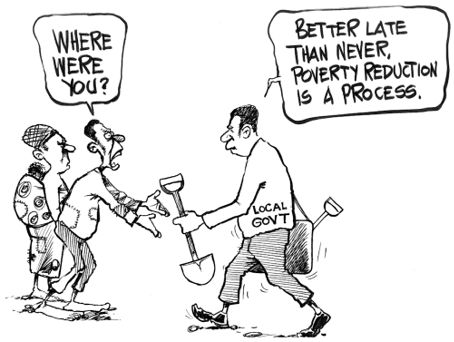
Besides this we are also witnessing the need to decentralize democracy, considering the fact that the concept of ‘nation’ was an invented phenomenon. Can we create a governance system where local government is given the authority to devise and implement their own community initiatives, while the central government could serve an integrating and regulating authority rather than being anything else? This was already tried out in a state-level micro-planning exercise done at Kerala facilitated by the Center for Development Studies, Trivandrum.
Similarly, in the field of management, given the extend of globalization happening at massive scale, companies are fast learning to lead their employees and manage their business as network of smaller companies, again the concept of ‘decentralisation’ in play.
We may have to seriously consider the way we manage our resources; and given the lessons learnt from the First World, it is necessary that the Third World makes more wiser decision both for its economy and common good. Decentralisation is one such way. 

Sunday, April 20, 2014

Current understanding on Assessment

It is surprising to know that, in the months of March-April, around 2.2 million students appeared for their X and XII public exams (and this is only the CBSE boards without including the State boards), making the Indian Examination system the largest of its kind anywhere in the world.


With such a staggering amount of population appearing for exams, it is necessary for us to look at ‘standard’ of such tests being conducted and henceforth its necessity and utility. Particularly I like to share my current understanding on the assessment, which was inspired by article I read an article on recently conducted Finnish Matriculation by Pasi Sahlberg.
At the premise, I want to question myself whether raising assessment standards can increase education excellence; and it is not as simple as setting tough question papers. And at the same time, I would like to declare that it doesn’t mean assessment standards are panacea for our bad education system. And at the same time, as mentioned in the Sahlberg’s article (which I highly recommend to read before continuing), we may have to be conscious of how this assessment is used, on teacher-designed assessments in the younger classes, one-time nation-wide assessment only when the children attain the age of 14 and be mindful that I am not supporting a mindless aristocratic system which rather than being progressive in nature, reduces the trust on the teachers.
Evidences
Given this common understanding, I like to put forth the evidences I particularly happen to witness in coming to such a judgment. However ill-informed or misunderstood I might be, I want this article to challenge the existing reforms in the Education sphere and invite more such constructive discussion on the same.
Ø  We are recently witnessing a visible decline in the quality of Engineering graduates in Tamil Nadu. Though a variety of reasons could be cited, experience faculty and trainers seem to site the cancellation of TNPCEE (Tamil Nadu Professional College Entrance Exams) in the year 2005. I personally took coaching classes on the same and remember it testing the conceptual understanding of the students rather than on rote learning usually being done in the regular public exams.
Ø  Visible difference in the high standard of Engineers, Doctors coming out of IIT/ Medical colleges because of the high standard of assessment set in the entrance exams like IIT-JEE, All India Entrance Exams, etc. Again a high standard of assessment ensuring quality intake into the colleges and henceforth better graduates
Ø  Recent trend in UPSC exams introducing high standard aptitude test, C-SAT (Civil Services Aptitude Test) to ensure quality placement, besides the knowledge-based assessments
Ø  Another example are the list of qualifying exams like IIM-CAT exams, GMAT, TOEFL, IELTS which on a scale tests the quality of intakes
Ø  Plethora of placement tests conducted for recruiting graduates (again testing aptitude and thinking skills) into the industry
Ø  We do have specialized tests and assessment like entrance test for B.Arch and test at National Institute of Design – are all assessments at different level to recruit specific type of candidates that the course demands
Here we should be mindful that assessment is not just quantitative or written measures; we may have to bring back our forgotten tradition of conducting oral assessment (one of the best and only way to assess students’ language and communication skills), literally like interviews for children.
What is the standard of assessment?
Quoting from the book, Driven by Data by Paul Bambrick-Santoyo, listed here are series of questions basically trying to test the students’ understanding on percentages.
  1. What is 50% of 20?
  2. What is 67% of 81?
  3. Shawn got 7 correct answers on his science test out of ten possible. What percentage of questions did he answer correctly?
  4. J.J.Redick was on pace to set a college basketball record in career free throw percentage. Going into the NCAA tournament in 2004, he had made 97 of 104 free throw attempts. What percentage of free throws had he made?
And the list goes on to 6 different types of questions. As it is clear, the assessment has the power to test however aptly the conceptual understanding of the students on the topic. Elsewhere I have written an article on Assessment in Constructive teaching taking inspiration from Mr.Rajendran’sbook Inikkum Kanakku.
Analysing the above questions will help us understand the current problems in our own system. We, in India, are always citing the lack of conceptual and practical application in our Mathematical education. I suppose level 3 and 4 questions tries to address that issue and at the same time challenges the formula-substitution method of Maths instruction insider our classroom. Such varying degrees of assessments are called ‘Scaffolded assessments’ denoting the increasing level of complexity it requires to solve the questions.
What increasing assessment standards can do?
Immediately, increasing the standard of assessments challenges the teachers to increase their level of instruction to address the conceptual understanding (like in Question 4) rather than to be satisfied with procedural instructions (like in Question 1 or 2). No, I am not suggesting that this alone will do, but this is a good place to start.
At the same time, questions on how such increase in standards can be achieved in a subject like English. I found answer in the Maharashtra State Board’s English exam question paper and the Finnish English Matriculation exam. Here English is tested on a different level rather than asking the students to reproduce a memorized lines of Shakespeare or re-narrate an episode from The Scarlet Pimpernel. Here English is tested at comprehension level and critically on the students’ understanding of the given text. Also, certain companies like Educational Initiatives, Science Olympiad Foundation, etc are bringing about novel initiatives in raising the assessment standards like producing high quality test materials like ASSET, National Math/ Science Olympiad.
Issues to handle
At the same time, we too end up in falling into the trap of teaching for the test or coaching for the exams happens. But I am wondering, if we could somehow navigate the issue some other way.
We should remember that assessment is everywhere. You will not be allowed to drive your car, if you are not ‘tested’ for your driving skills or one doesn’t want to sit in a plane without a licensed pilot. While these assessments are test of skills, can we also recommend using assessment only as a test of skill and knowledge in our education too? The question still lingers.    

Tuesday, April 15, 2014

How to make a child write story

How to develop the necessary skills to help children write a story? The pragmatic linear approach asks us to detail the necessary steps to master the skill of writing story. But telling children like – “Do you know how to write a story? First you have to…” doesn’t work.
There is another way of looking at. “There should be an interest to write story – a need to write one. A child shouldn’t be conscious that she/he is learning to write the story. They themselves should discover the necessary characteristics in making a story.” If we are working under this paradigm how can we teach children about writing story? We know that if we give them the knowledge of how to write a story, it will stay as information and it may go away. But if there was an opportunity for the children to discover it for themselves, the knowledge gained may be deeper and will help them apply in new situations.
So let us see how to make that happen:

  • Narrate a story and stop the story in a place where it peaks their interest [Suddenly there was a knock at the door… And the running race started…]
  • Ask the children to predict what happens next in the story and ask them to write it. ‘Do you know what happened next?’ ‘Can you guess who won the race?’ ‘Can you write what happens next?’ [Here the children write the story without knowing steps to write one. They are writing on their own as they wish]
  • Now to check who has written properly, we can introduce the story which will have all the essentials of writing a story.
  • Let the children read the ‘exemplar’ story
  • They compare their story with this story. Then, give them chance to correct their own stories based on the ‘exemplar’.
  • Can help others evaluate their stories so as to improve it.
  • If we repeat this exercise two or three times, the children get the nuances of writing a story without being taught.
  • Here, the children had taught themselves how to write a story, the teacher merely facilitated the process by providing a situation for that. (Remember: To create an interest in a concept/ subject of discussion should be the main aim of a teacher.)

Tuesday, April 8, 2014

What ET can do for Education

Students can have real time feedback whether the answer is right or not


There is no authority figure when a computer teachers a child – automatic transition from being taught to learning by myself happens
Easy to train/ equip a computer rather than train a teacher
Physical and cognitive workload of a teacher reduces – she/he now no more have to ‘perform’ every day in and day out
Teacher becomes facilitator of a pre-programmed structure
Automatic M&E of students’ performance
Reduces teachers’ work
  • Don’t have to invent questions or design assessments
  • Don’t have to correct test papers and track students’ progress
  • Don’t have to be a content expert (Can teach the topic without knowing the subject)
  • Can teach English without knowing English (becomes less teacher dependent)


Friday, March 14, 2014

How to make a child write story

(Adopted from Tamil Amuthu by Mr.G.Rajendran)

How to develop the necessary skills to help children write a story? The pragmatic linear approach asks us to detail the necessary steps to master the skill of writing story. But telling children like – “Do you know how to write a story? First you have to…” doesn’t work.

There is another way of looking at. “There should be an interest to write story – a need to write one. A child shouldn’t be conscious that she/he is learning to write the story. They themselves should discover the necessary characteristics in making a story.” If we are working under this paradigm how can we teach children about writing story? We know that if we give them the knowledge of how to write a story, it will stay as information and it may go away. But if there was an opportunity for the children to discover it for themselves, the knowledge gained may be deeper and will help them apply in new situations.

So let us see how to make that happen: 
  • Narrate a story and stop the story in a place where it peaks their interest [Suddenly there was a knock at the door… And the running race started…]
  • Ask the children to predict what happens next in the story and ask them to write it. ‘Do you know what happened next?’ ‘Can you guess who won the race?’ ‘Can you write what happens next?’ [Here the children write the story without knowing steps to write one. They are writing on their own as they wish]
  • Now to check who has written properly, we can introduce the story which will have all the essentials of writing a story.
  • Let the children read the ‘exemplar’ story
  • They compare their story with this story. Then, give them chance to correct their own stories based on the ‘exemplar’.
  • Can help others evaluate their stories so as to improve it.
  • If we repeat this exercise two or three times, the children get the nuances of writing a story without being taught.

Here, the children had taught themselves how to write a story, the teacher merely facilitated the process by providing a situation for that. (Remember: To create an interest in a concept/ subject of discussion should be the main aim of a teacher.)

Friday, December 6, 2013

The Art and Practice of Followership

These days we have an increased interest in Leadership and its development. Almost every organization wants to improve and nurture this capability within its employees. Lately I have come to see a little more practical truth in the other way around as well. I call this concept – ‘Followership’. Though not an expert in commenting on the art and practice of Leadership, I like to shed the light on my own definition of what I mean by ‘Followership’.
We do demand initiative, responsibility from almost everyone. But I have come to understand that we do need people who would conform and do the tasks assigned to them, before critiquing on it. I agree that we shouldn’t be all blind followers of orders, but on the other hand we may require enough understanding of our tasks and it’s fitting into the big picture of it before we may resist it. We need to appreciate its existence in the first place and then get a firsthand experience of actually accomplishing the task and then take the liberty to reflect upon its outcome.
Here comes that follower, who will do this. He does his work for the sake of work. He doesn’t over-identify himself with it. He is detached. He is not his job description, but never does he fails to accomplish the tasks given to him. He takes initiative; he has the drive of course which helps him complete the task in its best quality. He does take responsibility for the job and could see the big picture of what it could mean. He moves on.
He doesn’t consider any job as menial; he doesn’t think that he is better for his job or that he deserves better. He takes his job at hand as a duty to be performed as citizen of the company, as a contributing member of the society. So he gets paid. He does take his pay, so as to take care of his physical needs and to run his household. But that doesn’t mean that he doesn’t love his job or that he is doing it mechanically or he is doing it for the sake of money. He has in fact chosen his job, for the love of it. Agreed it wasn’t a perfect marriage, but he strives on to achieve that perfection. He sharpens himself against the demands of his job. He moves on.
Steven Pressfield calls this as being a ‘Professional’. The detachment is a magnificent twist in his definition though it’s not implicitly stated by him. I find that resonating with the ancient wisdoms of India. He himself refers to Bhagvat Gita, ‘Do you work and there it ends!’ Swami Vivekananda goes on even criticizing that we are having a mind of trader; to buy and to sell; to give and to take. But he asks us to just give; it may come back to us thousand folds greater. But that shouldn’t be our expectation. We should just give our best.
This mentality I believe will give us the magnanimity not to feel cheated of having high hopes, rather give us even headedness to accept and treat victory and failure alike. This even headedness itself will give us that necessary detachment from our work and reduce our anxiety towards performing. In fact, Swami Vivekananda actually says that this detachment will in fact make us better performers and increase the quality of our work. Though it sounds like a paradox, I personally want to try it.
Great man, a karma yogi, seems to have realized that. He moves on. He continues to do his duty, despite the ups and downs and his limited power and influence. He moves on. He works hard at perfecting himself and in liberating himself. He believes that it is by perfecting himself that he will be able to manifest a greater change in world than by anything. May be that is when, Gandhi must have declared, ‘Be the change you want to see in this world!’ It is no use blaming the others for what is happening around. It is up to us to take up that responsibility in trying to do our bit, our contribution in making this world a better and beautiful world.

May God bless us all!

Wednesday, August 28, 2013

Choosing a career


He was in a dilemma – one of my close friends – to make a decision for his career! I suppose almost everyone in their late 20s or early 30s come to a point of mid-life career choices and changes.
But this friend was a little different. Instead of letting impulse take over, he applied an analytical process in choosing his career. I learnt about his methods and was personally fascinated by it! Here is his method.
Unlike a fresher searching for a job, it is interesting to see how different a mid-career dynamics work. My friend was no more in a position of distress to search for a job; rather he had a luxury to be offered more jobs than he wanted. That’s where his dilemma started – an expanded list of choices, all seeming good, leaving him pretty confused.
He had four different job offers – all were good in their own aspect. But my friend doesn’t want to settle down for less than the best – he was of course in a critical juncture of his career and personal life. Being a meticulous person, he decided to list out the criteria that he was currently looking for in a job.  Here is his list.
·         Salary: He wanted to make sure that the ‘salary’ was on the list, unlike before. For his previous choices, he knew that ‘salary’ wasn’t a criterion, but now quoting him, ‘also money’ – salary become an important criterion.
·         Location: Neither was location. He has roamed around the globe and this time he decided to stay close to his family.
·         Security: In terms of the job’s nature and continuity for another 10 years at least.
·         Stability: Of the institution
·         Growth: Of the sector, institution and his own skill sets
·         Mentors: Within the institution, within the sector for whom he taught he could seek guidance
·         Match/ Suiting: To his own temperament – whether we like it or not, not all of us are made the same
·         Marriage: Of course he is going to marry soon and doesn’t want his job nature to affect his personal life and vice versa.
As you could see the list was very personal for him and he was careful in listing it and defining it for himself. It could be different for somebody else.
Given the above criteria for the job, he rated each of the job profile he was offered on a scale of 1-3: 1 being bad, 2 being okay and 3 being good.
Here are his ratings:
Criteria
PK
MRT
AFC
TRS*
Salary
2
1
1
3
Location
3
1
2
3
Security
3
3
2
2
Stability
3
1
2
2
Growth
3
2
2
2
Mentors
1
2
3
1
Suiting
2
1
3
1
Marriage
2
1
1
3
Total
19
12
16
17
*Names of the organizations are changed.
Finally, he calculated the total of the ratings. Based on the above analysis and introspection, he did choose the job that rated the highest.
Now it has been a month since he joined the new organization.

Friday, August 9, 2013

The Art of Mathematics


I found this interesting question in one of the articles I was reading on Calculus,
“A rectangle is to be formed by using a piece of wire that is 36 inches long. What will its dimensions be if it encloses the greatest area?”
Here, we have a problem that states, the perimeter of a rectangle is 36 inches, and we have to deduce the dimensions of that rectangle (length and breadth) which will have the greatest area possible.
I have been trying to calculate that.
To cut the long story short, I have made the following table, given the fact that everybody knows that the formula.
Perimeter of a rectangle = 2 (l + b) units
Area of a rectangle = l X b sq. units
With the above conditions, the possible dimensions of the length and breadth should have a sum of l + b = 18
If, 2 (l + b) = 36,
Then, l + b = 18
So the possible dimensions are, 17 + 1, 16 + 2, and 15 + 3… so on

Table: Perimeter v/s Area of the rectangle
P=2(l+b)
36
36
36
36
36
36
36
36
36
l+b
18
18
18
18
18
18
18
18
18
A=lXb
17
32
45
56
65
72
77
80
81
l
17
16
15
14
13
12
11
10
9
b
1
2
3
4
5
6
7
8
9

I have even plotted a graph for that Perimeter against Area. 


With Perimeter being constant at 36 inches, the greatest area is achieved at 81 sq. inches, and the dimensions of length and breadth is 9 inches.
Here is the interesting part, it makes a square. Yes, the rectangle with the greatest area is a ‘square’.
I tried working out for other possible values of perimeter as well. For every problem, it comes that “area with the greatest rectangle is a square, for the given value of perimeter.”
So what?
If you  have constructing or living in a home, we could now deduce that best possible room with the maximum amount of space/ area will be a square with the same amount of mortar used (perimeter value).
But we don’t usually build square rooms, do we?
On the other hand, it has been a very common practice among us, as told by our forefathers, the best possible dimensions of a room will be a product of two consecutive odd numbers, say – 9 X 11, 11 X 13… etc… This has serious amount of scientific reasoning into it, for the product of two consecutive odd numbers is the ‘second best’ spacious dimension for the given amount of perimeter.
Interesting isn’t it?
So two conclusions that has kept me thinking were,
  1. The possibility that there could be two rectangles with same perimeter but varying area
  2. A square is the largest rectangle with maximum area for the given perimeter 
Oh the beauty of Maths!!